
Why Empty Entryways Kill First Impressions in Listing Photos
Here’s the dirty little secret of listing photography: buyers start judging a home before they’ve emotionally stepped inside. And if the entryway looks like a sad patch of flooring with a blank wall and the charisma of a dentist’s waiting room, you’ve already lost momentum. Not forever, perhaps. But enough to matter.
Entryways are tiny transition zones with oversized influence. They set rhythm, scale, and emotional expectation. In a well-presented listing, the foyer tells the buyer what kind of experience the rest of the home promises. In a vacant listing, it often tells them absolutely nothing. That’s not minimalism. That’s just wasted narrative real estate.
This is exactly where AI virtual staging earns its keep. A strategically staged entry sequence can create visual flow, clarify function, and make the whole property feel more intentional. Done right, it doesn’t scream for attention. It quietly says, “Yes, this home has its life together.” Which, frankly, is more persuasive than half the listing descriptions on the internet.
The Entryway Is a Psychological Handshake
People don’t experience homes as spreadsheets. They experience them as stories. The first few images in a listing create emotional framing for everything that follows, and the entryway often appears before the kitchen, before the living room, before the dramatic lanai shot trying to rescue mediocre interiors.
When that opening visual feels cold or unresolved, buyers subconsciously assume the home lacks warmth, polish, or practical livability. An empty entryway can also distort scale. Without furnishings or styling cues, buyers struggle to understand whether the space is generous, cramped, formal, casual, or simply awkward. The result is hesitation. And hesitation is terrible for click-through behavior, inquiry volume, and the all-important “save this listing for later” instinct.
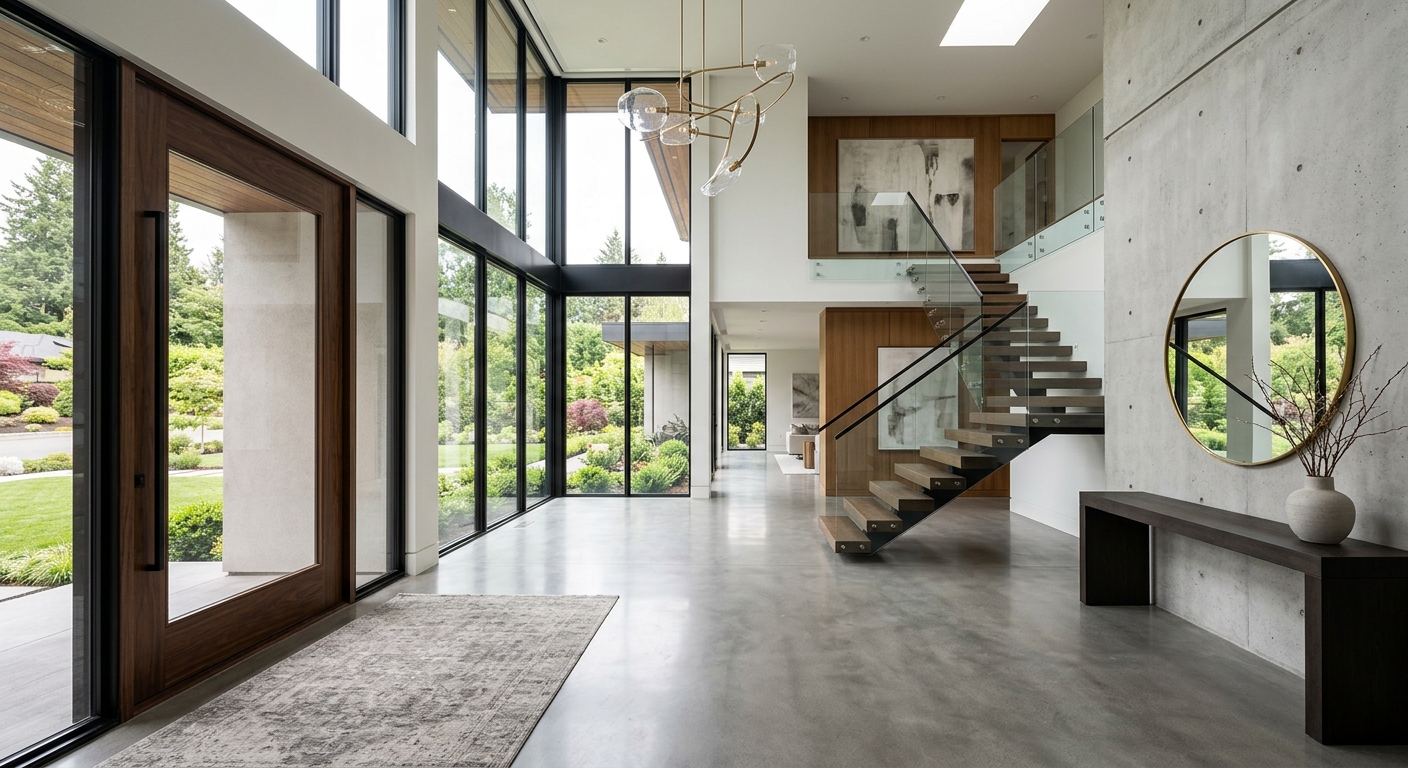
A staged entryway solves several problems at once. It suggests a natural arrival point. It introduces material contrast. It creates a sense of finish. A bench, console, mirror, runner, sculptural lamp, or a restrained bit of greenery can establish immediate logic: this is where keys go, shoes pause, guests orient themselves, and the home begins to make sense.
Why Vacant Foyers Photograph So Badly
Vacant spaces are unforgiving, but entryways are especially brutal because they tend to be narrow, high-contrast, and transitional. That means every flaw gets amplified. Harsh light, dead corners, odd wall proportions, and excessive floor area all become starring characters. No one asked them to audition, yet here we are.
From a photography standpoint, empty foyers often suffer from three recurring issues. First, they lack a focal point. The viewer’s eye enters the frame and immediately wanders off in search of purpose. Second, they expose circulation paths without defining them. So instead of feeling graceful, the space reads as leftover. Third, they magnify finish-level inconsistencies. A slightly bland light fixture or builder-grade door hardware suddenly feels like a design statement, and not in a fun way.
That’s why smart agents and photographers increasingly use AI staging not merely as decoration, but as visual correction. The goal is not to pile in random furniture like a discount furniture catalog exploded. The goal is to give the architecture a coherent opening sentence.
What an Effective AI-Staged Entryway Actually Needs
1. A clear anchor piece
A console table, compact bench, or narrow storage cabinet gives the space purpose. It tells the camera where to land and gives the buyer’s eye a place to rest. The best anchor pieces reflect the home’s broader style language rather than fighting it. Coastal homes want texture and lightness. Modern homes want restraint. Traditional homes can handle symmetry without looking uptight.
2. Vertical balance
Entryways often have a lot of wall and not much horizontal depth. Mirrors, art, or tall decor create balance without crowding circulation. This is where the Vision Builder approach matters: the staging should match both the architecture and the target buyer. A downtown condo entry might lean sleek and gallery-like, while a family-oriented suburban listing benefits from warmth and practical cues.
3. Controlled mood
Lighting and tonal balance matter more than people realize. A foyer with warm wood floors but icy digital lighting feels off in a way viewers can’t always articulate. Vibe Staging helps align the emotional temperature of the image so the entryway feels inviting instead of accidentally clinical. You want “welcome home,” not “please take a number.”
4. Visual flow to adjacent rooms
The entry image should preview what comes next. If the foyer opens into a living room or sightline toward the kitchen, the styling should guide the eye naturally toward that next reveal. This is where composition and staging work together. The best listing sequences feel effortless, which is annoying, because it means someone did their job extremely well.
Why This Matters for Marketing Performance
Listing performance is shaped by micro-decisions. A buyer decides whether to keep swiping, tap for more photos, schedule a showing, or move on to the next tab in roughly no time at all. An empty entryway may seem like a minor issue, but weak opening imagery lowers perceived value across the whole listing.
When the first impression feels polished, the rest of the property benefits. Rooms look more connected. The home feels more designed. The price feels easier to justify. This is one reason virtual staging consistently supports stronger engagement: buyers don’t merely see empty square footage, they see usable, aspirational living patterns.
And if you want to go beyond still images, Magic Motion can turn that staged entry sequence into a cinematic opening beat for the listing. Instead of dropping viewers into a static frame, motion can guide them through the threshold and into the home’s broader story. It’s subtle, memorable, and far more sophisticated than the usual slideshow with inspirational ukulele music.
Design Rules That Keep Entryway Staging Credible
Believability is everything. If the staged furniture is oversized, stylistically random, or physically impossible, buyers notice. Maybe not consciously, but they notice. Good virtual staging respects circulation, scale, and architectural truth.
For narrow foyers, keep furniture depth conservative and leave breathing room around the door swing. For grander double-height entries, resist the urge to overfill. A few elegant pieces often outperform a cluttered setup trying too hard to prove the house has personality. Let the architecture lead. Staging should support the room, not campaign for elected office inside it.
Texture also matters. Entryways benefit from tactile contrast: wood against plaster, a woven runner against tile, matte ceramics against reflective hardware. These details make the image feel photographed rather than fabricated. That distinction matters for buyer trust and brand credibility.
Where Staging Wizard Fits In
This is precisely the kind of image problem Staging Wizard was built to solve. If you want a fast answer, Wizard’s Choice can generate a polished entryway concept without a week-long design committee and three rounds of second-guessing. If you want more control, Vision Builder lets you dial in style, buyer intent, and mood with far more precision.
The point is not simply to fill a blank space. It is to create a marketable first impression that feels specific to the property. A staged foyer should help the listing read as complete, cohesive, and easy to imagine living in. That’s what turns a passable image set into a persuasive one.
The Real Lesson: Stop Treating the Foyer Like a Throwaway Shot
Agents obsess over kitchens, primary bedrooms, and outdoor entertaining spaces, which makes sense. But the entryway is where the emotional contract begins. If that first moment is flat, the rest of the listing has to work harder to recover. In a competitive market, that’s a silly handicap to accept voluntarily.
So no, the foyer is not just a hallway with ambitions. It’s a conversion point. Treat it like one. Stage it with intention, photograph it with discipline, and use AI tools to make the opening frame feel as considered as the rest of the home. Buyers may not say, “Ah yes, excellent arrival sequence.” But they will feel it. And feeling it is what gets them to keep going.


